• All Posts
  • CEO Advisory Group
  • newsletter
  • Vistage Events
  • Vistage Speakers
  • Webinars
  • Vistage Testimonials
  • Events
  • podcast Episode
  • Business
  • Vistage Members
  • Future Trends
  • Economic Trends
  • Leadership Strategies
  • Marketing Monday
  • Vistage Business Transaction Center
  • Membership Types
  • Extra News
4 Minutes Read

Zero Economic Profit: Understanding How It Works

In economic terms, "Zero Economic Profits" refers to a situation where a firm's total revenue exactly equals its total costs, including both explicit and implicit costs. This concept is also known as "zero economic profit" and is distinct from accounting profit.

Key Aspects of Zero Economic Profit

  • Definition and Calculation
    Zero economic profit occurs when a firm's total revenue is equal to the sum of its explicit and implicit costs. The calculation takes into account not only the direct monetary costs (explicit costs) but also opportunity costs (implicit costs) associated with the use of resources.

  • Distinction from Accounting Profit
    It's important to note that zero economic profit does not necessarily mean the firm is making no money. A firm can have a positive accounting profit while simultaneously having zero economic profit. This is because accounting profit only considers explicit costs, while economic profit factors in both explicit and implicit costs.
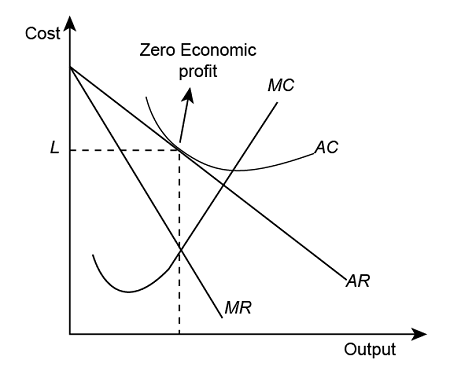
Zero Economic Profits graft
  • Long-Run Equilibrium
    In perfectly competitive markets, zero economic profit is often associated with long-run equilibrium. 

    In this situation:

    1. Firms have no incentive to enter or exit the market

    2. Resources are being used efficiently

    3. Firms are earning just enough to keep them operating in the industry

  • Market Dynamics
    The concept of zero economic profit plays a crucial role in understanding market dynamics:

    • If economic profits are positive, it incentivizes new firms to enter the market

    • If economic profits are negative, firms are motivated to exit the market

    • When economic profits are zero, the market is in equilibrium, with no pressure for entry or exit

Implications and Significance

  • Resource Allocation
    Zero economic profit indicates that resources are being allocated efficiently in the economy. Firms are earning just enough to keep their resources employed in their current use, rather than in the next best alternative.

  • Competitive Markets
    In highly competitive markets, the tendency towards zero economic profit in the long run helps explain why firms in such markets often operate on thin margins.

  • .Business Strategy
    Understanding the concept of zero economic profit is crucial for businesses in assessing their performance relative to opportunity costs and in making decisions about market entry or exit.In conclusion, "Zero Profits" in economic terms represents a state of equilibrium where firms are covering all their costs, including opportunity costs, but not earning excess returns. This concept is fundamental to understanding market dynamics, resource allocation, and long-run equilibrium in competitive markets.

Zero-profit condition

Economic concept related to competitive markets

  • Definition - Occurs when the economic profit per firm in an industry is driven down to zero by competition

  • Market Competition - In a perfectly competitive market, firms continue to enter until there is zero profit per firm

  • Variables - Key variables include price of output (p), price of input (w), amount of output (f(x)), and amount of input (x)

  • Profit Function - Profit function is to maximize (price of output * amount of output) - (price of input * amount of input)

  • Contestable Markets Theory suggests that firms may set prices as if potential entrants were already in the market, even without actual entry

Zero profit is an important concept in economics, and its significance can be explained in simpler terms with some practical examples. Here's why it matters:

Market Equilibrium

Zero profit indicates a state of balance in the market. It's like a sweet spot where businesses are making just enough to keep going but not so much that everyone wants to jump in.

  • Example: Food Truck Business
    Imagine a city where food trucks are becoming popular. At first, some trucks make big profits. This attracts more food truck owners to the area. As more trucks arrive, competition increases, and profits start to shrink. Eventually, the market reaches a point where food truck owners are making enough to cover all their costs (including the salary they could have earned elsewhere), but not much more. This is zero economic profit.

    City with zero economic profits

Resource Allocation

When industries reach zero profit, it suggests that resources are being used efficiently across the economy.

  • Example: Tech Startups
    During a tech boom, many people might leave their jobs to start new companies. As the market becomes saturated, some startups succeed while others fail. Eventually, the industry settles into a state where starting a new tech company is about as profitable as other career options. This indicates that talent and resources are being distributed efficiently between tech and other sectors.

Long-term Sustainability

Zero economic profit doesn't mean businesses are failing; it means they're sustainable in the long run.

  • Example: Local Bookstore
    A bookstore owner might earn enough to pay all the bills, pay herself a salary comparable to what she could earn elsewhere, and keep the store running smoothly. While she's not getting rich, the business is stable and can continue operating indefinitely. This is a state of zero profit.

Market Entry and Exit Decisions

The concept helps explain why businesses enter or leave markets.

  • Example: Rideshare Driving
    When rideshare apps first launched, many drivers earned high profits. This attracted more drivers, increasing competition. Eventually, earnings settled to a point where driving was about as profitable as other similar jobs. At this point (zero economic profit), the number of drivers stabilizes – there's no rush of new drivers joining, nor are existing drivers quitting en masse.

Understanding True Profitability

Zero economic profit helps businesses and individuals make better decisions by considering all costs, including opportunity costs.

  • Example: Home-based Business
    Someone might start a home-based business and celebrate making $50,000 in their first year. However, if they left a job paying $60,000, they're actually experiencing an economic loss of $10,000, even though they have a positive accounting profit. This understanding can help them make better decisions about continuing or changing their business strategy.

In summary, the concept of zero economic profit is important because it helps explain market behavior, guides resource allocation, indicates market stability, and assists in making informed business decisions. It's a key idea for understanding how markets function and how businesses operate in the long term.


Sources

  • https://library.fiveable.me/key-terms/microeconomic-analysis-for-business-decisions/zero-economic-profit

  • https://en.wikipedia.org/wiki/Zero-profit_condition

  • https://homework.study.com/explanation/what-does-it-mean-when-a-company-makes-zero-economic-profit.html

  • https://socialsci.libretexts.org/Bookshelves/Economics/Economics_(Boundless)/9:_Production/9.3:_Economic_Profit

Business

0 Comments

Write A Comment

*
*
Please complete the captcha to submit your comment.
Related Posts All Posts
05.28.2026

Why Investing in Small and Midsize Businesses Strengthens Our Economy

Update Why Small and Midsize Businesses Are the Cornerstone of Our Economy As we observe National Small Business Month, it's crucial to acknowledge the vital role that small and midsize businesses (SMBs) play in shaping the economic landscape of the United States. These companies represent a staggering 99% of all businesses, providing jobs for nearly half of the U.S. workforce. They are more than mere profit-driven entities; they serve as the backbone of our economy, contributing significantly to community health and their local economies. The Power of Job Creation in the SMB Landscape In times of economic uncertainty, the capacity of SMBs to create jobs is of utmost importance. Entrepreneurs such as those at Multipet International, a family-owned pet toy business, showcase how effective leadership produces not just employment opportunities but also robust company cultures. By fostering workplaces centered around teamwork and respect, these businesses enhance employee satisfaction and spur growth within their communities, resulting in a cascading effect of local empowerment. Innovation: The Driving Engine Behind SMBs The narrative of innovation is critical for the survival and growth of SMBs. Entrepreneurs like Brandon LaVielle of Lavish Roots exemplify how adaptability can lead to success. In response to economic shifts, LaVielle's company has diversified its revenue streams, setting ambitious goals such as producing 2.5 million meals annually. This strategy emphasizes a balance between maintaining tradition and embracing innovative practices, crucial for standing out in competitive markets. In an era where conventional methods no longer guarantee success, adaptive strategies represent a beacon of hope for aspiring enterprises. Building Strong Community Connections SMBs possess a profound connection to their local communities, frequently serving as primary supporters of local charities and initiatives. Their intimate understanding of community needs enables them to tailor services and offerings that resonate deeply with residents. For consumers, shopping at local businesses is not merely a transaction; it fosters a positive feedback loop that reinforces community ties, making the economy more resilient by emphasizing collective growth. The Economic Multiplier Effect: A Community Investment Investing in SMBs translates into bolstering the local economy. Research indicates that approximately $0.67 of every dollar spent at local businesses remains within the community, unlike larger corporations, where only $0.43 is reinvested locally. This multiplier effect underscores the critical nature of such investments, demonstrating their importance in creating sustainable local economies capable of weathering downturns. Practical Steps to Support Small Businesses Consumers eager to aid SMBs can take actionable steps that directly contribute to their sustainability. Strategies include shopping locally whenever possible, spreading positive reviews online, and utilizing social media to enhance their outreach. Participating in community events and purchasing gift cards also proves beneficial, empowering businesses while nurturing the economic fabric of the community. A Cautiously Optimistic Future for SMBs The outlook for small businesses remains cautiously bright, with a recent report indicating that 74% of small business owners anticipate revenue increases in 2026 and nearly 60% are planning to expand. However, they also face considerable challenges, such as rising operational costs and labor shortages. These obstacles necessitate strategic planning and a willingness to adapt to changing circumstances. Collaborative Ecosystems: Enhancing Business Viability To thrive, small businesses require supportive ecosystems that equip them with necessary resources. States like North Carolina exemplify successful collaboration among community colleges, economic development initiatives, and local businesses. This partnership provides invaluable training and resources that foster innovation and sustainable growth, showcasing a path forward for others seeking to create robust local economies. Conclusion: The Importance of Supporting SMBs In conclusion, supporting small and midsize businesses is an investment in the vitality of our communities and the future stability of our economy. By nurturing job creation, innovation, and community engagement, we can collectively strengthen the backbone of our society. The ripple effects of supporting SMBs are profound, leading to a healthier economy and vibrant communities, making it essential for everyone to join in fostering this critical sector.

05.27.2026

Investing in Our Future: Why Supporting Small and Midsize Businesses Matters

Update The Vital Role of Small and Midsize Businesses As we celebrate National Small Business Month, it's essential to recognize that small and midsize businesses (SMBs) serve as the backbone of the American economy. Representing a staggering 99% of all businesses and providing jobs for nearly half of the U.S. workforce, these companies are more than just commercial entities—they are fundamental to community health and economic resilience. Job Creation: A Pillar of SMB Success In today's economic landscape, characterized by uncertainty and rapid technological advancements, job creation remains critical. SMBs, led by passionate entrepreneurs, are typically at the forefront of this effort. For instance, Multipet International, a family-owned pet toy business, demonstrates how strong leadership can create not just jobs, but also a vibrant company culture based on teamwork and respect. This commitment fosters a positive workplace that encourages employee growth and satisfaction, thereby creating a ripple effect of community well-being. Innovation: The Driving Force Innovation is vital for differentiation and growth, and SMBs are proving adept at navigating challenges. Entrepreneurs like Brandon LaVielle of Lavish Roots have reimagined their businesses in response to economic shifts, focusing on diverse revenue streams and robust workforce development. With the goal of producing 2.5 million meals annually, Lavish Roots is just one example of how SMBs balance tradition with innovative practices to carve out spaces in competitive markets. The Community Connection: More Than Just Business SMBs are deeply rooted in the fabric of their communities, often acting as the first supporters of local charities and initiatives. Their intimate knowledge of local needs allows them to tailor products and services that resonate with residents. By shopping at local businesses, consumers can create a positive feedback loop that strengthens community ties and encourages collective economic growth. Economic Impact: The Multiplier Effect Investing in SMBs is not simply a matter of convenience; it's an investment in the local economy. Research shows that for every dollar spent at local businesses, approximately $0.67 remains within the community, which starkly contrasts with larger corporations, where only $0.43 is reinvested locally. This multiplier effect is crucial for fortifying local economies capable of withstanding downturns. Practical Ways to Support SMBs Consumers eager to support small businesses can take specific, impactful actions. Shopping locally, spreading positive reviews online, and using social media to promote SMBs can amplify their reach. Additionally, purchasing gift cards and participating in community events directly contributes to business sustainability, thus fostering a stronger local economy. Future Outlook: Opportunities and Challenges The outlook for small businesses remains cautiously optimistic. According to reports, 74% of small business owners expect an increase in revenues in 2026, with nearly 60% planning to expand. Nonetheless, they face challenges, including rising operational costs and labor shortages, which require strategic planning and adaptation. The Role of Collaborative Ecosystems States like North Carolina highlight the importance of supportive ecosystems for small businesses. Resources such as community colleges and economic development initiatives provide essential training and support. By fostering collaboration among startups, established businesses, and educational institutions, communities can encourage innovation and sustainable growth. Why Supporting SMBs Matters In conclusion, supporting small and midsize businesses means investing in our communities and future economic stability. It allows us to foster innovation, job creation, and entrepreneurship that collectively build the backbone of our society. As a community, let's commit to championing our local businesses by shopping small and engaging with our neighborhoods. Now is the time to act. By taking these steps, you contribute to a vibrant, resilient economy that benefits everyone.

05.25.2026

Discover How AI Empowers Local Businesses to Unlock Growth

Update How AI is Reshaping Business LandscapeIn an age defined by rapid technological advancements, Artificial Intelligence (AI) has emerged as a transformative force in the business world, particularly for Main Street businesses. Unlike corporate giants that often dominate headlines, local enterprises across the United States are tapping into AI tools to enhance operations, improve customer service, and make data-driven decisions that were previously out of reach. The accessibility of AI technologies means that even small business owners can leverage these resources to boost efficiency and growth.The Power of Predictive AnalyticsOne crucial aspect of AI that benefits Main Street businesses is predictive analytics. This powerful tool analyzes historical data to forecast future trends, allowing business owners to make proactive decisions. For instance, local retailers can use predictive analytics to anticipate customer purchasing habits and manage inventory more effectively. By tailoring their strategies based on data, businesses can enhance their service offerings and ultimately increase profitability.Streamlined Operations for Increased EfficiencyAI helps streamline various operational processes—from managing supply chains to automating customer service. Chatbots, powered by AI, deliver 24/7 assistance to customers, ensuring immediate responses to inquiries, which enhances customer satisfaction. For example, a local cafe can deploy an AI chatbot on its website to handle reservations and answer common questions, freeing up staff to focus on in-person customer interactions and food preparation.Enhancing Marketing StrategiesMarketing is another realm where AI proves invaluable. By analyzing consumer behavior and preferences, AI tools enable businesses to create tailored marketing campaigns that resonate with their target audiences. With tools like social media analytics and customer segmentation models, businesses can deliver personalized messages that are more likely to convert leads into sales. This targeted approach not only maximizes return on investment but also fosters a deeper connection between the business and its clientele.Addressing Concerns: The Human Element in AIWhile AI presents numerous opportunities, there is an underlying concern about losing the human touch in customer interactions. It's essential for business owners to strike a balance between automation and personal engagement. Businesses that successfully integrate AI should also emphasize the value of human connection, ensuring that customers feel valued beyond just transactions. This approach not only enhances customer loyalty but also reinforces a positive brand image.Future Trends in AI for Local BusinessesLooking ahead, the role of AI in supporting Main Street businesses is expected to expand significantly. As technology continues to evolve, we can anticipate even more advanced AI applications tailored to meet the unique needs of local enterprises. From virtual reality shopping experiences to advanced supply chain management systems, the potential is limitless. Business leaders who remain open to these innovations will likely find themselves one step ahead in an ever-competitive marketplace.Conclusion: Embracing AI for Sustainable GrowthThe future of Main Street businesses hinges on adaptive strategies that incorporate advancements in AI. By embracing this technology, local enterprises can unlock growth, enhance customer experiences, and build resilience against market fluctuations. As business owners, stepping forward into the realm of AI means not just survival but thriving in a dynamically changing business landscape.

Terms of Service

Privacy Policy

Core Modal Title

Sorry, no results found

You Might Find These Articles Interesting

T
Please Check Your Email
We Will Be Following Up Shortly
*
*
*